Session Length: What Long Chats Cost in Context
Long sessions are where continuity pays off and where drift sets in, and the two effects arrive together. Characters are described as recalling previous interactions, so a long thread carries real context forward — but the same length that accumulates that context also gives a stalled scene time to repeat itself. The decision worth making deliberately is when to extend a session and when to start a fresh one.
Key takeaways
- Sixteen sessions a month at 15, 30 and 60 minutes comes to 4, 8 and 16 hours respectively.
- Context accumulates with length; so does the risk of a thread restating itself.
- Framing costs two minutes a session and matters most on the longest sessions, where drift is costliest.
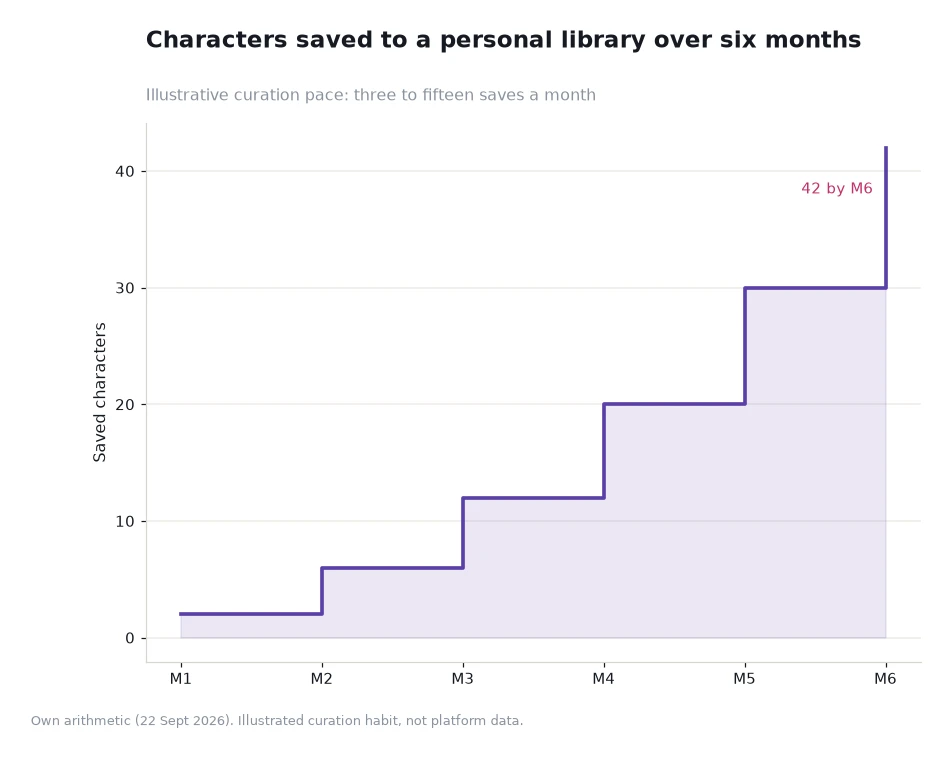
- A library reaching 42 saved characters in six months is the likely outcome of long, regular sessions, and it needs the same management as a long thread.
What a longer session actually buys
Three things improve with length. Context deepens, because a thread that has run for an hour contains more material for later replies to draw on. Continuity strengthens, since the character's recall includes the earlier part of the current conversation as well as previous visits. And the shape of the exchange changes: short sessions tend toward quick exchanges, while long ones allow a scene to develop through several beats.
For readers who value a developing conversation over a quick one, the hour is where that experience lives. It is also the length at which a session stops being a burst of attention and starts being a block of time that has to be found in a week — which is the honest cost of the longer format, and the reason most habits settle at half an hour rather than sixty minutes. It is also why a Porn Chat AI week made of one long block rarely beats four shorter visits, since the shorter format keeps restarting the framing that a long session gradually loses.
The tax: drift, repetition and re-reading
The cost of length is not a fee; it is the probability that part of the session is spent not moving forward. A thread that stalls at minute 22 of a 60-minute session leaves 38 minutes exposed, against 8 minutes in a 30-minute session. Nothing prevents the stall, but the exposure scales predictably with length, and that is the trade a reader is making when they extend a session.
Re-reading is the second tax. Long threads contain more to scroll back through when you want to check a detail, and the cost is measured in seconds per check across many sessions. It is small per instance and noticeable per month, and it is the main practical reason a reader might split an hour into two half-hours on consecutive days rather than one sitting.
When to extend and when to start fresh
Extend when the scene is still developing and your last few messages each added something new. Start fresh when the last few messages were variations of one line, when the premise has moved somewhere you did not intend, or when your only remaining move is to restate something already said. Those three conditions are readable in about twenty seconds and they answer the question better than any feeling about how the session is going.
A fresh thread is not a loss, because recall persists across conversations. Starting a new thread with the same character keeps the relationship while resetting the scene, which is usually the actual goal when a long session starts to drag. Readers who never start fresh are pushing length past its useful limit; readers who start fresh every session never build the context that makes length worth it.
| Session length | Hours a month | What it is good for |
|---|---|---|
| 15 minutes | 240 minutes, or 4 hours | Sampling and quick exchanges |
| 30 minutes | 480 minutes, or 8 hours | Developing a scene across several beats |
| 60 minutes | 960 minutes, or 16 hours | Long-form continuity, at a higher drift exposure |
| Framing cost | 2 minutes × 16 sessions = 32 minutes | Restating the premise so long threads do not repeat |
| Exposure at a stall | 8 minutes of a 30-minute session | 38 minutes of a 60-minute session instead |
| Library effect | 42 saves after six months at an illustrative pace | Long threads and large libraries need the same review habit |
Worked example: sixteen sessions, two lengths
Illustrative assumption: 16 sessions a month. At 30 minutes each the month is 16 × 30 = 480 minutes, or 8 hours. At 60 minutes each it is 16 × 60 = 960 minutes, or 16 hours. The difference between the two months is 8 hours, which is a full extra working day's worth of attention, and it arrives without any change to the schedule.
The library that such a habit produces can be counted the same way. Starting from 2 saves in month one, additions of 4, 6, 8, 10 and 12 produce 6, 12, 20, 30 and 42 saves by month six. Note that 42 saves over six months is 7 a month on average, and a library growing at that rate is the long-session profile's real output: more hours, more material, and the same obligation to review it. Long threads and large libraries are managed by the same discipline, which is deciding what to keep.
Putting length to work in a porn ai chat week
Match the length to the purpose rather than to the mood. Fifteen minutes for sampling, half an hour for development, an hour when a scene genuinely has several beats to run. Then apply the two-minute framing rule to any session longer than 30 minutes, where the exposure to drift justifies the overhead most clearly.
Two habits keep long sessions useful. Write one line at the end recording what the thread established, which takes seconds and saves minutes of scrolling next time. And treat the shift from one length to another as a decision to make once a month rather than mid-session, since a reader who extends because a conversation is going well tends to extend again the next time for the same reason. The AI chat blog covers how recall works if you want the mechanism rather than the practice, and a tag search is the fastest way to replace a thread you decided to abandon.
Frequently asked questions
Is a longer session always better?
No. Longer sessions build more context and carry more exposure to drift, so the right length depends on whether the scene has beats to develop. An hour that stalls for 38 minutes is worse than two 30-minute sessions that both move forward.
When should I start a fresh thread instead of continuing?
When your last few messages were variations of one line, when the premise drifted, or when your only move left is to repeat something already said. Recall persists across conversations, so starting fresh with the same character keeps the relationship.
How much time does framing add to a long session?
About two minutes, or 32 minutes across a 16-session month. That is roughly 6.7% of an 8-hour month, and it is the cheapest way to reduce the repetition that long threads are prone to.
Choose the length, then defend it
Decide the length before the week starts, frame the long sessions explicitly, and start fresh as soon as the scene stops developing. Length is the dial with the largest effect on monthly hours and the largest exposure to drift, which makes it the single decision most worth making deliberately rather than by default.
Data and sources: the Crushon porn chat page[1] for the description of how characters recall earlier interactions and adapt over time, read 22 Sept 2026. Every hour total, stall figure and library count here is illustrative arithmetic rather than platform data. Meant for adults 18 and older, and for nobody younger.