How to Read a Perfume OEM/ODM Manufacturer's Capability Before You Brief Them
Capability in fragrance manufacturing is not a certificate wall or a polished factory tour. The signals that predict a good outcome are narrower: whether the supplier compounds the formula they quoted, whether they fill and pack at your volume, and whether a technical question comes back answered, in writing, by somebody who works in the lab. Everything else is presentation, and presentation is cheap.
Key takeaways
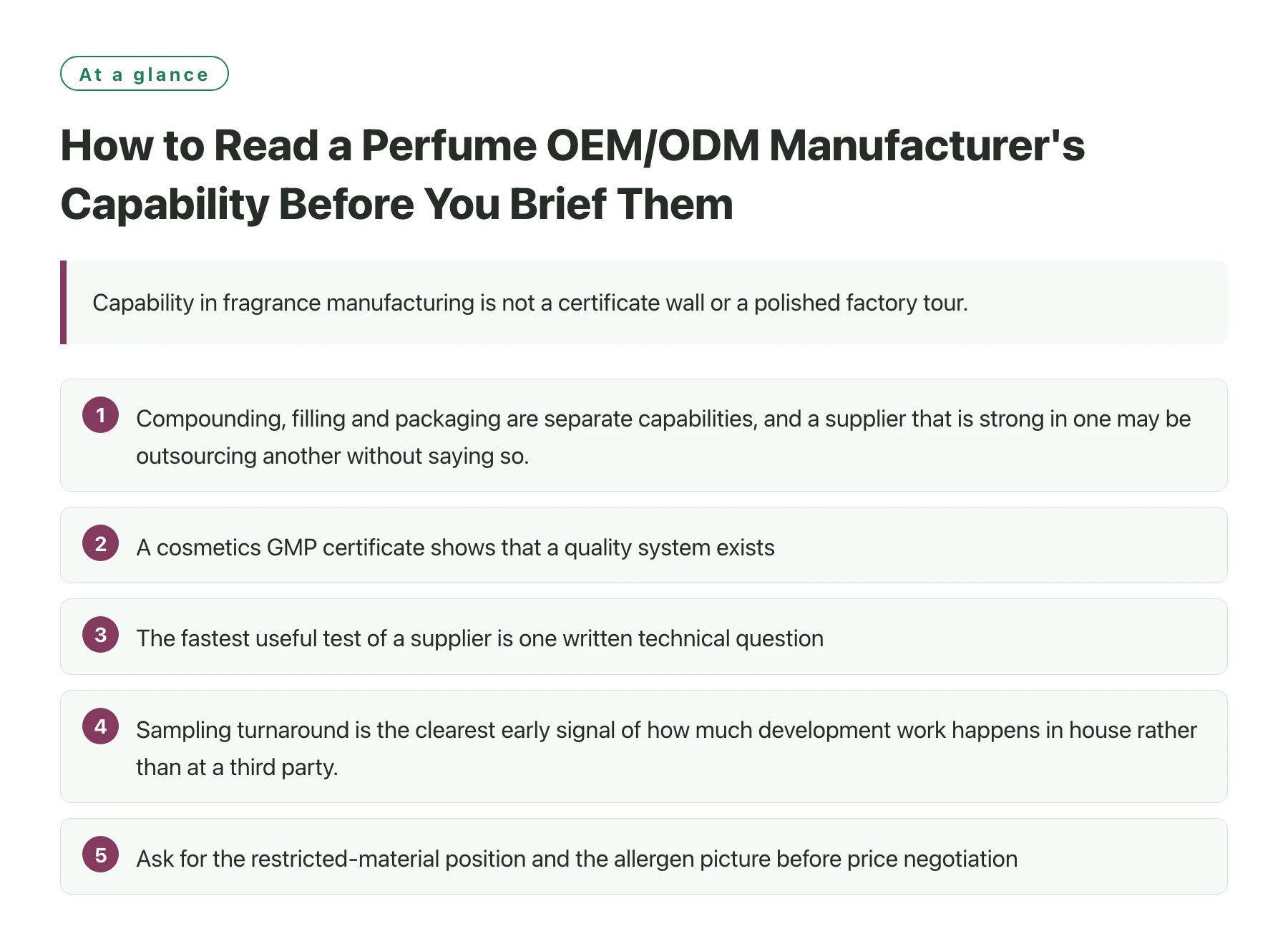
- Compounding, filling and packaging are separate capabilities, and a supplier that is strong in one may be outsourcing another without saying so.
- A cosmetics GMP certificate shows that a quality system exists, not that the system covers your product type or your order size.
- The fastest useful test of a supplier is one written technical question, because a real laboratory answers it and a trading office forwards it.
- Sampling turnaround is the clearest early signal of how much development work happens in house rather than at a third party.
- Ask for the restricted-material position and the allergen picture before price negotiation, because both can force a reformulation later.
Most supplier evaluations start with a spreadsheet of certificates and end with a video call. That order is backwards. Certificates are the easiest thing for any company to collect, including companies that will subcontract your entire order to somebody you never meet.
The practical question is not whether a factory is large or modern. It is which steps of your specific project they will perform, which steps they will buy in, and who is accountable when a step goes wrong. Those three answers are usually visible within two weeks if you ask precisely.
This article sets out what to check, how to phrase the questions so they cannot be answered with marketing language, and how to run the whole evaluation without visiting the site first.
What the phrase manufacturing capability really covers
In fragrance, production is a chain rather than a single act. Somebody blends the fragrance compound, somebody dilutes it into a carrier, somebody fills it into bottles, somebody labels and cartons it, and somebody holds the documentation. A supplier can own all five steps or only the middle two, and the quotation will look identical either way.
That is why capability has to be discussed step by step. A brand that assumes full in-house production and later discovers that filling was outsourced inherits a second quality system, a second lead time and a second point of failure that nobody priced.
Compounding, filling and packing are three different businesses
Compounding requires a perfumery lab, a materials library and a perfumer or application chemist. Filling requires clean filling lines, alcohol handling permits and volume-appropriate equipment. Packing requires decoration, assembly and cartoning capacity. A company can be excellent at one and average at the others.
So ask, for each step, whether it happens on their site or elsewhere, and ask for the name of the entity that performs it. Suppliers who do everything in house answer immediately. Suppliers who do not will describe a partnership instead of a facility.
Trade and technical publications describe how alcohol dilution and stability testing are handled in production, which gives a baseline for judging whether an answer is specific or decorative [3].
Certificates are a floor, not a ranking
Cosmetics GMP certification, typically assessed against the ISO 22716 framework, confirms that a documented quality system is in place for cosmetic production. Third-party testing and inspection firms audit these systems and describe the same scope limits in their own materials [1]. A certificate therefore tells you that processes are written down and audited. It does not tell you that the site has ever produced a product like yours.
The useful follow-up question is scoping: which product categories does the certificate cover, which lines were audited, and when was the last surveillance audit. A supplier who can answer that in one message is a supplier whose quality team is genuinely involved in sales conversations.
One written question beats one hour of sales talk
Send a precise technical question early, such as which materials in a proposed formula carry use restrictions under the published fragrance standards and how much headroom remains [2]. A manufacturer with a real development function will answer in technical language. A trading operation will reply with a promise to check, then with a general statement about quality.
The same test works for stability and compatibility: ask how the formula is expected to behave in the packaging you intend to use. Vague answers here are not a reason to walk away immediately, but they tell you that you will be managing the technical relationship yourself.
A capability checklist you can send to any supplier
| Capability area | The question that reveals it | What a vague answer sounds like | What settles the point |
|---|---|---|---|
| Compounding | Which materials in this formula are restricted, and how much headroom is left? | We only use high quality ingredients. | A written list of restricted materials with the remaining allowance |
| Filling and alcohol handling | Which line fills this bottle size, and what is the permitted alcohol storage on site? | We have advanced equipment. | Line identification and the licence or permit reference |
| Development | How many modification rounds are included, and who signs off a round? | We revise until you are happy. | A number of rounds written into the quotation |
| Documentation | Which documents travel with the bulk shipment and who issues them? | All certificates are provided. | A named document list with issuing party for each item |
| Continuity | What happens to my formula and moulds if we stop working together? | You own everything, always. | A clause naming what is returned, held or destroyed |
Fill this table in for two or three candidates before you compare prices. The differences that matter usually show up in the third and fourth columns, not the first, and they are much harder to fake in writing than in a meeting.
Running the evaluation in four weeks
- Week one: define your own specification firstWrite the product category, target markets, bottle format, expected annual volume and price ceiling before contacting anyone, so every supplier answers the same brief.
- Week one: send the same written questionnaire to all candidatesUse the checklist above plus your own questions. Identical inputs make the replies comparable, and the speed of reply is itself a data point.
- Week two: request one sample brief, not threeA single well-defined brief costs less and reveals more than three loose ones, because you can judge whether the direction was actually understood.
- Week three: test the sample on skin and in the intended packageCheck the dry-down at the two-hour and six-hour marks, and check compatibility with the bottle and pump you intend to use.
- Week four: ask the awkward questions in writingFormula ownership, mould ownership, subcontracting, minimum order quantity and what happens if a restricted material is reclassified.
- Week four: score, then negotiateScore capability before price, because a lower quotation from a supplier who cannot answer the technical questions is not a lower total cost.
The mistake that costs the most is choosing on price before capability has been tested, then discovering during the first bulk order that development, filling or documentation sits with a third party. By then the artwork is printed and the launch date is public. One written technical question and one sample round cost almost nothing and answer most of what a site visit would.
Reading the answers once they arrive
By the end of a proper evaluation you should have a shortlist of two, each with a filled checklist, one sample and a written position on ownership. The remaining work is interpretation, and it is less about finding a supplier with no weaknesses than about knowing which weaknesses you can live with.
Established manufacturers such as Xuelei publish their certification scope and service range openly, which shortens the first pass, but the same written questions still have to be asked of every candidate. A published scope describes what a company does in general; only your questionnaire describes what it will do for this product.
Weight the areas against your own risk
A first-time launch with a small volume should weight development and sampling flexibility heavily, because the formula will change. A repeat order of a proven product should weight filling consistency and documentation, because those two decide whether the second shipment matches the first.
Writing those weights down before the scores arrive prevents the common drift where the friendliest supplier quietly becomes the highest rated one.
Keep one credible backup warm
Fragrance materials go out of specification, lines go down, and seasonal demand fills capacity. A second evaluated supplier who has already seen your brief can take over in weeks rather than months, which is the same risk logic you would apply to any single-source input.
For a stage-by-stage walkthrough of the same evaluation, including the questions to ask in the sampling round, see perfume OEM/ODM manufacturer.
Sources
- SGS: Cosmetics, Personal Care & Household Testing —— Testing, inspection and certification services for cosmetics and personal care, including microbiological, stability and safety testing aligned with cosmetics GMP.
- IFRA Standards Library (International Fragrance Association) —— The IFRA Standards Library lists the restrictions the fragrance industry applies to individual fragrance ingredients, based on safety assessments; it is the reference point for compliant fragrance formulation.
- Cosmetics & Toiletries —— A technical magazine for cosmetic formulators, covering ingredients, formulation science and testing methods.
Frequently asked questions
Do I need to visit the factory before signing a manufacturing agreement?
Not necessarily before, but before the first large order. A written questionnaire and one sample round answer most capability questions remotely. A visit adds value once you know which specific step you want to see, such as filling, alcohol storage or the stability testing area.
What does a cosmetics GMP certificate actually prove?
It proves that a documented quality management system for cosmetic production has been audited against a recognised framework such as ISO 22716. It does not prove that the site has produced your product type or your volume before, so ask which categories and lines the certificate covers.
How many sample rounds should a manufacturer include in a quotation?
Two to three modification rounds is a workable norm for a new fragrance direction, with the number written into the quotation rather than agreed verbally. If the brief is unusual or the price ceiling is tight, expect the first round to be exploratory and budget accordingly.
Is it a problem if a supplier subcontracts part of the work?
Not by itself, because many manufacturers buy in bottle decoration or specialised filling. The problem is not knowing. Ask which steps are subcontracted, to whom, and which quality system governs that site, then decide whether you accept the additional coordination risk.
What should I ask about formula ownership?
Ask in writing what happens to the formula, the moulds and the artwork if the relationship ends, and which of them you may take to another manufacturer. Also confirm whether the formula is developed exclusively for you or drawn from a shared library used for other clients.