Checklist: Planning Seasonal Garden Product Orders
Seasonal garden orders need a calendar that connects forecast, supplier capacity, packaging, shipment, and selling dates. A missed production slot can leave inventory arriving after peak demand, while an overestimated forecast ties up cash and storage. Buyers should separate planning signals from firm commitments and track each SKU through production and delivery.
Key takeaways
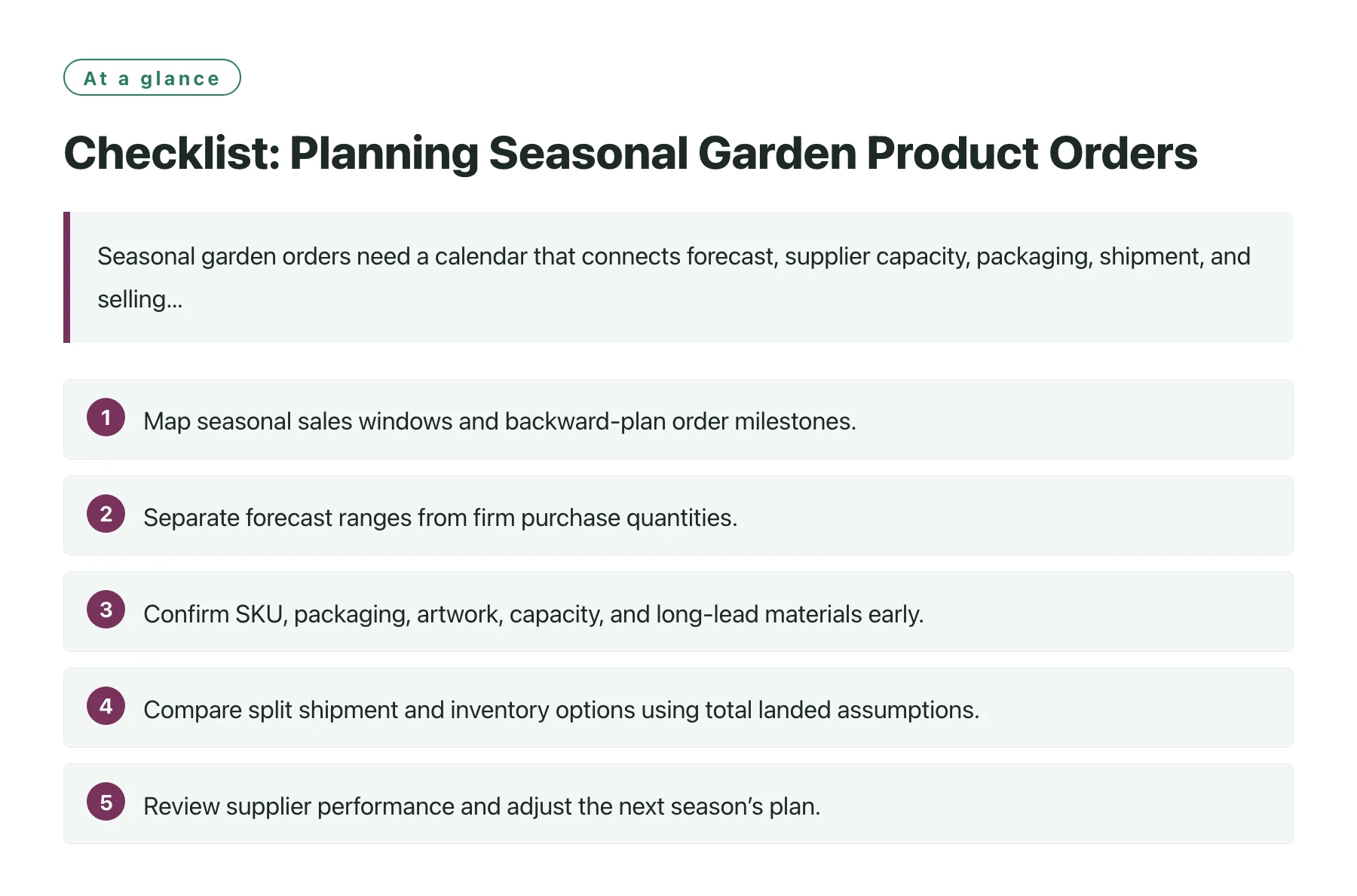
- Map seasonal sales windows and backward-plan order milestones.
- Separate forecast ranges from firm purchase quantities.
- Confirm SKU, packaging, artwork, capacity, and long-lead materials early.
- Compare split shipment and inventory options using total landed assumptions.
- Review supplier performance and adjust the next season’s plan.
A seasonal order plan works when demand signals, factory commitments, and delivery dates stay distinct and visible.
1. Build the product and season calendar
List SKU, category, color, size, package, sales region, planned launch, peak demand, and end-of-season date. Identify products exposed to weather or dependent on outdoor installation. Group items only when they share supplier and process dependencies.
Work backward through design approval, samples, artwork, production, inspections, consolidation, transit, customs, receiving, and distribution. Include buffers for delays, rework, and holiday periods.
For each milestone, record the planned date, latest acceptable date, dependency, owner, and evidence of completion. Distinguish the customer-facing launch date from warehouse receipt and the date inventory must be available for allocation. A calendar becomes actionable when the team can see which late decision threatens the selling window.
2. Segment products by demand and supply risk
Classify stable repeat items, seasonal launches, promotional variants, long-lead products, and single-source components. Use different reorder rules for fast movers and uncertain new products. Identify which items can be substituted without harming customer expectations.
Estimate forecast confidence and consequences of shortage or excess stock. Record assumptions behind demand ranges and review them with sales, marketing, and operations before suppliers reserve capacity.
3. Separate forecast from firm order
Send a rolling forecast with horizon, update cadence, and uncertainty range. Issue a distinct purchase order for firm quantity, price, product revision, and delivery window. State whether the supplier may buy materials based on forecast and who pays for unused stock.
Clarify cancellation, postponement, quantity tolerance, price validity, and capacity reservation. Written terms prevent a planning estimate from being mistaken for a guaranteed purchase commitment.
Use a forecast version and date so both sides can tell which estimate is current. If suppliers purchase seasonal materials early, agree how quantities will be reconciled against the final order and whether unused materials can be carried into another run. Confirm how forecast updates affect capacity and quoted lead times.
4. Confirm SKU and packaging readiness
Lock dimensions, materials, finish, labels, barcodes, assortment, carton configuration, instructions, and retail display requirements early. Custom packaging and seasonal artwork may have longer lead times than product assembly.
Check package counts and marks by SKU and sales region. If multiple varieties share cartons or pallets, document the mix and how warehouses distinguish them. Approve a packaging sample where damage or sorting errors would be costly.
5. Verify supplier capacity and materials
Ask for current production loading, critical material availability, subcontractors, changeover time, and schedule by SKU. Compare the proposed start date with the factory’s actual commitments and previous seasonal performance.
Identify supply bottlenecks and alternatives. A second supplier is useful only if product, packaging, tooling, and market approval can transfer with acceptable time and cost.
Request a SKU-level schedule instead of one overall promise. Ask what happens if a key resin, metal component, printed carton, or imported accessory is delayed. Validate proposed alternatives against the approved specification and market needs before treating them as available contingency options.
6. Plan inspections and shipment release
Set sample, in-process, final, packaging, and document checks proportionate to product risk. Define lot identity, acceptance criteria, sample plan, reporting deadline, deviation owner, and shipment release authority.
Schedule checks before the latest practical correction point. Seasonal time pressure is not a reason to ship with unresolved critical defects; use contingency inventory or split releases if contractually feasible.
Define what happens when inspection identifies a defect: containment, sorting, repair, replacement, reinspection, or written concession. Set the person authorized to accept a deviation and identify which findings block shipment. Keep inspection timing separate from the carrier booking cutoff so corrective work remains possible.
7. Compare transportation and inventory scenarios
Evaluate full container, consolidated freight, split shipment, air replenishment, and earlier bulk production using consistent volumes, costs, dates, and risk. Consider warehouse capacity, cash tied up, obsolescence, and the cost of late arrivals.
Specify the delivery rule and named place in the contract. ICC Incoterms® rules clarify certain delivery tasks, costs, and risks; separately model transit, customs, destination handling, and distribution timing. [1]
8. Monitor during the selling season
Track actual demand, sell-through, returns, defects, inventory, shipment status, and open supplier actions. Set a trigger for reorder, transfer, markdown, or cancellation. Confirm the supplier’s available capacity before promising customers a replenishment date.
Keep decisions and forecast revisions dated. If changes are too late for the current production cycle, record the next feasible shipment and customer or channel response.
During the season, compare orders, sell-through, open purchase orders, inventory on hand, inbound dates, and forecast by SKU. Escalate a likely shortage early enough to evaluate a feasible replenishment route. For slow movers, agree whether to stop production, defer a release, or redirect inventory before the season ends.
9. Close the season and update next year
Compare forecast accuracy, lead time, defect trends, packaging damage, supplier response, and landed cost. Record which products sold out, arrived late, or remained in stock. Update assumptions and supplier capacity data for the next season.
Buyers ordering garden supply wholesale from China can ask for a shared calendar, SKU tracker, sample status, inspection milestones, and shipping scenarios before the new cycle opens.
Sources
Frequently asked questions
When should seasonal garden orders be placed?
Work backward from the selling date through sample, production, inspection, shipment, customs, receipt, and distribution, adding realistic buffers.
Can a forecast reserve supplier capacity?
Only if the parties agree what is reserved, for how long, what commitment exists, and who bears unused-material cost.
How should buyers manage an uncertain new SKU?
Use demand ranges, limit initial commitment where feasible, confirm replenishment options, and track sell-through before expanding.
What should be reviewed after the season?
Compare forecast, quality, timing, damage, inventory, supplier performance, and landed cost, then update next year’s plan.